

Accountant SEO services should do five things for your firm: complete your Google Business Profile, give every service and location its own page, answer the questions clients already ask, build a steady flow of reviews, and keep the technical basics clean. Done in that order, they put your firm in front of people who are searching for a CPA, a tax preparer or a bookkeeper right now. This guide explains what each part involves, what it looks like for financial advisors and consulting firms, and how to judge an SEO provider before you sign.
TL;DR
- Accounting searches show three things at once: the map results, the ordinary organic results and AI answers. Good SEO covers all three.
- Each service (tax, bookkeeping, payroll, advisory) needs its own page, written from the client’s point of view.
- Google treats financial advice as “Your Money or Your Life” content, so credentials, bios and real client experience carry weight.
- Financial advisors and broker-dealer-regulated firms must keep content fair and balanced, so compliance review belongs in the workflow.
- Judge any provider by a clear diagnosis, a prioritized plan and reporting tied to leads, not rankings alone.
Table of Contents
- Why SEO for accountants is not generic local SEO
- What accountant SEO services should include
- How to structure your site around how clients search
- Building E-E-A-T when the work is confidential
- SEO for financial advisors and consulting firms
- Compliance: keep content fair, balanced and reviewable
- Visibility in AI answers
- Measuring what matters
- Choosing a provider and setting a budget
- How our plans fit an accounting firm
- FAQ
- Sources
Why SEO for accountants is not generic local SEO
When a prospect searches for an accountant, the results page shows three different things: the map results driven by Google Business Profiles and reviews, the organic results below them for more specialist searches, and AI answers from Google’s AI Overviews and assistants such as ChatGPT. A plumber can win with a good map listing alone. An accounting firm usually needs all three layers working together.
The reason is trust. Google classifies accounting and financial advice as “Your Money or Your Life” content, which means stricter quality standards. Your site has to show experience, expertise, authoritativeness and trustworthiness (E-E-A-T). In practice that means named partners, credentials, real client examples and content written by people who do the work.
The weighting depends on your firm. According to the same guide from The Firm, a generalist suburban practice should lean toward the map results, while a niche firm should lean toward service pages and answers. Most firms are a bit of both.
| Firm type | Where most leads come from | Where to put effort first |
|---|---|---|
| Generalist suburban CPA | “Accountant near me” and map results | Google Business Profile, reviews, location pages |
| Niche firm (e.g., restaurants, real estate, crypto tax) | Specific organic searches and AI answers | Service pages, industry pages, answer content |
| Multi-office firm | Both, split by office | One page and one profile per real location |
| Advisory or CFO-focused firm | Long, specific questions | Answer content, bios, case studies |
What accountant SEO services should include
A useful scope covers the following, roughly in this order.
1. A complete Google Business Profile
For many firms this is the single highest-return task. The Xero guide notes that local SEO and a well-optimized profile are among the highest-return activities because most prospective clients search for services near them. That means the right primary category, accurate hours, services listed, photos of your office and team, and consistent name, address and phone details across directories.
If you want this handled for you, our Google Business Profile optimization and local SEO services cover the profile, citations and map visibility.
2. A page for every service and every location
One “Services” page that lists tax, bookkeeping, payroll, advisory and virtual CFO work gives Google one thin page for five different searches and gives a prospect no reason to choose you. Each service deserves its own page, written from the client’s perspective, with your approach, the clients you serve and what makes your firm different.
3. Answers to the questions clients already ask
People ask specific things: whether they need an S corp election, how to handle quarterly estimates as a freelancer, what records to keep for an audit. Content that answers those questions earns organic traffic and gets cited in AI answers. You do not have to give away the engagement. Explain how the decision works and when it needs a professional.
4. A consistent review habit
Ask every client for a review the same way every time, for example in the closing email after a return is filed or a quarter is closed. Consistency beats occasional bursts, and reviews feed the map results directly.
5. Technical basics, checked on a schedule
Fast mobile pages, clean indexing, working forms, secure hosting and structured data for your organization and services. The Firm’s advice is to fix these once and then check them quarterly, which keeps the work from becoming a constant drain.
How to structure your site around how clients search
Think of your site as a set of answers to specific searches, each with its own page.
- Service pages: individual tax preparation, small business accounting, bookkeeping, payroll, IRS representation, CFO services.
- Audience pages: pages for the industries or client types you serve, such as contractors, medical practices or e-commerce sellers.
- Location pages: one per real office, with local details, not a template with the city name swapped.
- People pages: bios with credentials, licenses, years of experience and the kinds of clients each person works with.
- Resource pages: guides, checklists and answer articles that link back to the relevant service.
Each page should have one clear purpose, a plain headline that matches the search, proof of experience and a single next step, usually a consultation request. Internal links connect answers to services so that a reader who finishes a guide on estimated taxes can move straight to the page for your tax planning service.
A small-firm example: a three-partner CPA practice serving restaurants in one metro area would build a restaurant accounting page, a restaurant payroll page, a page on sales tax for food service, and a Google Business Profile with matching services. It would also publish two or three answers about tip reporting and inventory, each linking back to the service page. That is a focused plan that a small team can finish and maintain.
Building E-E-A-T when the work is confidential
Accountants cannot publish client names or numbers freely, so the proof has to be framed carefully.
- Use anonymized case examples: the situation, what you did and the type of result, with no identifying details.
- Show credentials: CPA licensure, enrolled agent status, memberships and continuing education.
- Publish bios that explain who handles what, in plain language.
- Write commentary on changes that affect your clients, signed by the person who wrote it.
Capital Group’s guidance for advisors says that bios, case studies, market commentary, speaking engagements and podcasts can all help demonstrate experience, and that investors look for professionals who have navigated similar situations many times before. The same logic holds for tax and accounting clients.
SEO for financial advisors and consulting firms
The same structure carries over to related professions, with a few adjustments.
Financial advisors
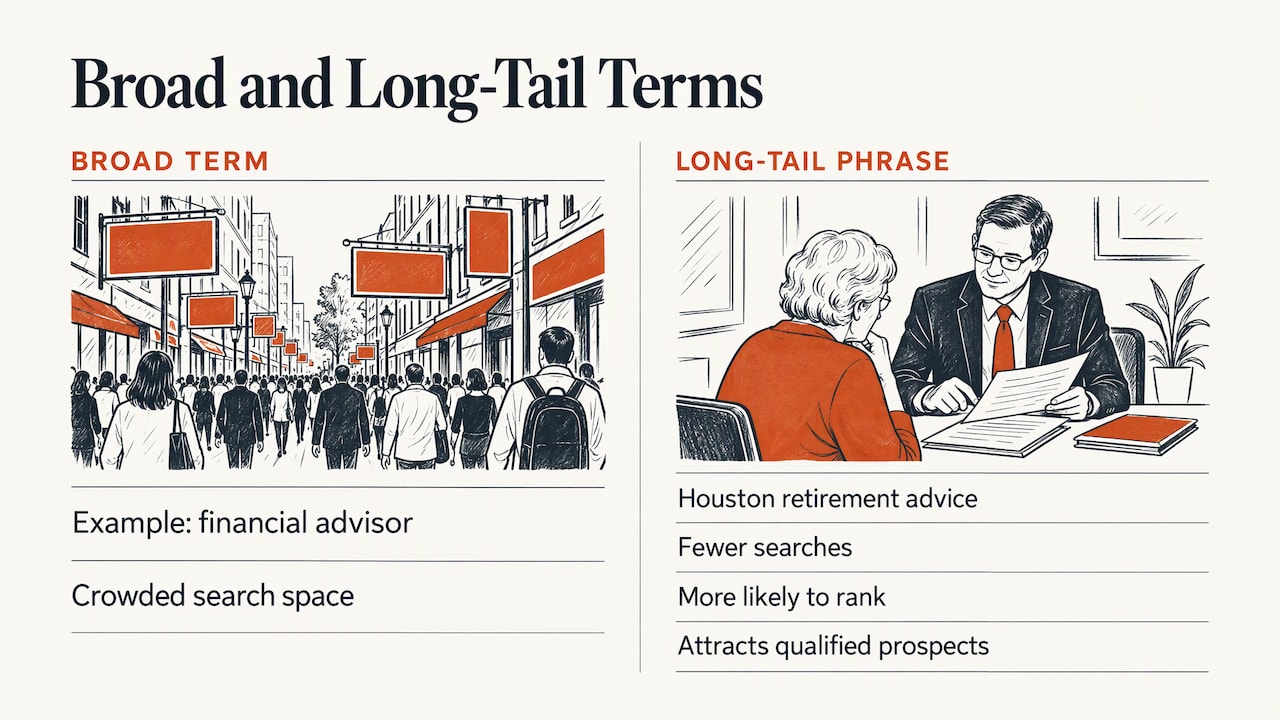
Broad terms are crowded. Schwab Advisor Services recommends long-tail phrases such as “Personalized retirement advice for Houston business owners” over a term like “financial advisor”, because the specific phrase gets fewer searches but is more likely to rank and attract qualified prospects. SmartAsset makes a similar point and suggests localized content, such as articles about estate planning laws in your state or how probate works in your county, to build local authority.
A good plan for an advisor therefore pairs a profile and local pages with niche pages (retirement planning for physicians, equity compensation for tech employees) and answers to the questions those groups ask.
Consulting firms and other professional services
Consultants often have the opposite problem: their best work is bespoke and hard to package. A practical approach is to separate the work that can be named and searched for, such as compliance reviews, benefits design or process audits, from the judgment-heavy work. Build ranking pages for the first group, and let the depth of that content show the quality of thinking behind the second. Our own SEO consulting work follows the same principle: diagnose first, then focus effort where it changes results.
Compliance: keep content fair, balanced and reviewable
CPA firms follow their state board and professional-standards rules on advertising. Firms that are FINRA members face more. FINRA’s guidance on advertising says communications, including chatbot content, may count as correspondence, retail or institutional communications and must be supervised under applicable rules, and that content must be fair and balanced and not misleading by omission under Rule 2210(d).
In practice, build compliance into the workflow rather than bolting it on:
- Agree which pages and posts need review before publishing.
- Keep a record of approved versions.
- Avoid performance promises and guaranteed outcomes in page copy and testimonials.
- Check any AI-assisted drafting or site chat features against your supervisory procedures.
If you are a registered firm, confirm the specific rules that apply to you with your compliance officer or counsel before publishing.
Visibility in AI answers
People now ask assistants questions like “how do I find a CPA for my LLC?” Those answers draw on pages that are clear, specific and well structured. The steps above already help: service pages with plain explanations, bios, schema markup, consistent profile data and answers written for real questions. Our AI SEO services focus on this layer, covering GEO, AEO and LLM optimization, so your firm is a credible source when assistants answer local and specialist questions.
Measuring what matters
Rankings alone do not pay the bills. Track the numbers that connect to new clients:
- Calls, form submissions and consultation requests, by source.
- Google Business Profile actions: calls, direction requests, website clicks.
- Organic traffic and click-through rate in Google Search Console and Google Analytics.
- Rankings and citations in AI-generated results, along with backlinks and referral sources.
- Lead quality: how many inquiries became booked consultations and signed engagements.
Review these monthly, but judge the program on a quarterly view. Tax season creates seasonal swings, so compare against the same period a year earlier where you can.
Our perspective
We have worked on search since 2012, and the pattern in professional services is consistent: firms win when the work is focused, not when it is bulk. An accounting firm does not need two hundred thin articles. It needs a profile that is complete, a page for each service it wants more of, proof that real people with real credentials do the work, and answers to the questions clients actually ask.
That is why every engagement starts with a diagnosis of the problems that hold your site back most, followed by a tailored 90-day roadmap. The most impactful fixes come first, whether that is a technical issue, an underbuilt service page or a gap in local authority. You see what is being done and why, with reporting tied to leads rather than vanity numbers.
We built our approach to avoid automated, low-quality tactics, which matter even more in a field where trust decides who gets the call. Our clients report strong returns, with a 3:1 average return on investment across our engagements, and we plan each program around realistic goals.
Affordable SEO Plans
Choosing a provider and setting a budget
Use these criteria to compare options, whether the provider is a specialist agency, a generalist SEO firm or a freelance consultant.
| Criterion | What good looks like |
|---|---|
| Diagnosis | A clear audit of technical issues, service pages, local presence and authority before work begins |
| Prioritization | A written roadmap that says what happens first and why |
| Scope | Profile, service and location pages, content, technical fixes, reviews and structured data |
| Compliance awareness | A workflow that lets your partners or compliance team approve content |
| Reporting | Leads, calls and consultations by source, not only rankings |
| Fit | Experience with small firms, multi-office practices or enterprise sites, as your firm requires |
If you are a smaller practice, a small business SEO program is usually the right size. Larger multi-office firms and networks can look at corporate and enterprise SEO. Agencies that serve accountants can also deliver the work under their own brand through a white-label reseller program.
How our plans fit an accounting firm
Our monthly plans start at $799 for Starter SEO, $1,299 for Business SEO and $1,699 for Ultimate SEO, each priced from those amounts per month. Each engagement begins with a diagnosis and a customized 90-day roadmap, so a firm that needs a profile cleanup and four service pages starts there, while a multi-office firm can scope more.
See the plans and request a roadmap for your firm on the Affordable SEO Plans homepage.
FAQ
How long does SEO take to bring in accounting clients?
Map results and a repaired Google Business Profile can move sooner than organic page rankings, while new service pages and answer content build over several months. Competition in your city and the state of your current site affect the pace. A 90-day roadmap lets you see which fixes were completed and how enquiries are changing.
Do I need a separate page for each accounting service?
Yes, in most cases. A single page listing every service gives Google one thin page for several different searches. Separate pages for tax, bookkeeping, payroll and advisory let each one match a specific search and speak to a specific client.
What is different about SEO for financial advisors?
The fundamentals are the same, but advisors compete for broader and tougher terms and face stricter advertising rules. Long-tail, local and niche phrases tend to attract more qualified prospects, and every page should pass your compliance review. Bios, case examples and commentary help demonstrate experience.
Can a consulting firm use the same approach?
Yes. Turn the repeatable parts of your work into pages that can rank, such as audits, compliance reviews or program design. Show the bespoke, strategic work through the depth and quality of that content, plus bios and case examples.